Space Domain Awareness Platform
ORION
A modular platform for integrating orbital data, automating analysis, and supporting operational decision-making in space awareness workflows.
What is ORION?
ORION is a modular Space Domain Awareness (SDA) platform designed to integrate heterogeneous orbital data sources, standardize them, and make them usable for analysis, catalog maintenance, and operational insights. The project focuses on reducing manual effort and improving traceability across the data lifecycle.
From ingestion to user-facing analysis, the platform is structured to support catalog management, propagation, risk detection, and decision support in a unified architecture.
How ORION works
Data acquisition
Collects orbital information from multiple public and open-source providers such as Space-Track, CelesTrak, SatNOGS, DISCOSWeb and UCS DB.
Normalization
Unifies different schemas and naming conventions around shared identifiers such as NORAD ID and standardized orbital metadata.
Analysis and reporting
Enables catalog updates, propagation tasks, and decision support through a modular analysis environment and API access.
Architecture overview
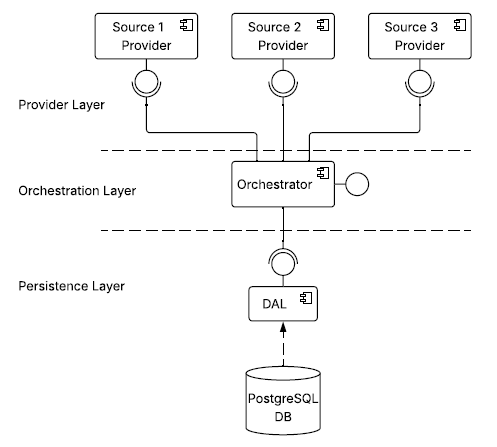
ORION follows a layered modular architecture that separates data acquisition, ETL orchestration, storage, and end-user interaction.
| Layer | Responsibility | Key Components | Description |
|---|---|---|---|
| Provider Layer | Data ingestion | Space-Track, CelesTrak, SatNOGS, DISCOSWeb, UCS DB | Interfaces with external sources and retrieves heterogeneous orbital data |
| Orchestration Layer | ETL processing | Scheduler, Normalizer, Deduplicator, Fusion Engine | Standardizes and consolidates data using NORAD ID and unified schemas |
| Persistence Layer | Data storage | PostgreSQL + SeaORM | Ensures structured storage, relational integrity, and historical tracking |
| Interface Layer | User interaction | React SPA + Axum API + SSE | Provides visualization, APIs, and real-time updates |
System architecture diagram
Design principles
Modularity
Each SDA capability operates as an independent functional component while sharing a unified data backbone.
Transparency
Data acquisition, transformation, and lineage are intentionally visible to support auditability and reproducibility.
Scalability
The architecture separates ingestion, orchestration, storage, and interaction to support growth in data volume and users.
Autonomy
ORION is designed to reduce dependence on proprietary systems by combining open data sources and modular services.
Demonstration videos
SATCAT catalog workflow
Demonstration of the SATCAT catalog workflow and its role in organizing orbital data.
Propagation
Demonstration of how the propagation process works and how orbital states evolve over time.
Project team
- Juan Camilo Beltrán Garnica (Universidad de los Andes) jc.beltrang1@uniandes.edu.co
- Danna Lucia Castillo Palacios (Universidad de los Andes) d.castillop@uniandes.edu.co
- David Camilo Ocaña Orbes (Fuerza Aeroespacial Colombiana) david.ocana@fac.mil.co
- Mateo Cubides Galeano (Fuerza Aeroespacial Colombiana) mateo.cubides@fac.mil.co
- Mario Linares Vásquez (Universidad de los Andes) m.linaresv@uniandes.edu.co
This project is developed in collaboration between:
- Fuerza Aeroespacial Colombiana (FAC)
- Universidad de los Andes